Wednesday, February 16, 2011

Steve Jobs, Dr. Thomas Szasz and Innovation

STEVE JOBS


I just started reading this paper.  Principle #2 relates to what we were talking about last night.  The following is from it:


In 1976, Steve Wozniak was captivated by Jobs’ vision to “put a computer in the hands of everyday

people.” Wozniak was the engineering genius behind the Apple I and the Apple II, but it was Jobs’ vision that inspired Wozniak to focus his skills on building a computer for the masses. Jobs’ vision was intoxicating because it had four components that all inspiring visions share: It was 1) bold, 2) specific, 3) concise, and 4) consistently communicated.


This is just what I was talking about.  Steve Jobs was the abstract visionary of the innovation (see http://adhdldsupport.proboards.com/index.cgi?board=adhdkids&action=display&thread=501 as to why I label him abstract) and Steve Wozniak was the logical one that had what I call innovation out of desperation (I don’t know if it’s really proper to label Wozniak logical or not; for all I know, he might be just as abstract as Jobs is).  Just like Kennedy and NASA.


DR. THOMAS SZASZ


I also had another thought relating to why I think there are supposed to be us abstract thinkers.  I think that many of the so-called mental maladies of this past century and a half have come about because we people of this world may be trying to squeeze square pegs into round holes.  By that I mean that before the Industrial Revolution, when so many people went from living outside of cities to living within the constraints of them, I’m betting that it was a bit easier for both abstract and logical thinkers.  To some extent, a person  found the way in life that suited each person the best.  I bet that even at the beginning of the Industrial Revolution, an abstract didn’t have it quite so hard.  However, if you look back over just the 20th century, you can see the constraints that we as a society have put upon ourselves.  Children now spend the greater part of the day, 5 days in a row, confined to desks, mentally concentrating for long periods of time.  Their parents do the same for even more hours.  I’m amazed that even the logical can do that and not go crazy.  Were we, as a species, really meant to mentally live this way?  How does this relate to my original thought?  I believe that there is suppose to be ‘innovation out of nothingness’ (the abstract ‘what ifs’) just as much as ‘innovation out of desperation’ (the logical minds such as those at NASA that made Kennedy’s vision of us on the moon a reality).  I also think that the world that we have created for ourselves, in order to keep people and things going, no longer caters to the mental freedoms we once had.  Those who follow the beat of a different drummer have it harder and harder, IMO, as we progress farther and farther in this technology-laden world.


This page that I found with Dr. Szasz speaking is great.  He says what I know to be true: ADHD is not a disease.  http://spoken-gems.com/2009/07/28/dr-thomas-szasz-adhd-is-not-a-disease/


Thanks ….


From: Business Technology Alert [mailto:Business_Technology_Alert@businesstechalertinfo.net]
Sent: Wednesday, February 16, 2011 10:19 AM
Subject: Innovate the Steve Jobs Way: 7 Insanely Different Principles for Breakthrough Success


February 16, 2011


GoToMeeting Corporate

Questions?

1-800-372-6207


7 Principles for Breakthrough Success


Download the Complimentary eBook

Monica:

"Steve Jobs" is synonymous with "innovation." So it's no wonder Fortune named Jobs CEO of the Decade. From company culture and customer service to products and marketing, Jobs does, indeed, think differently.

This new eBook by Carmine Gallo, columnist for BusinessWeek.com, explores the 7 guiding principles of Steve Jobs' success and how you can use them to emerge from the recession stronger, more inspired and more innovative than ever.

Download the eBook to learn:

·         Why mastering your message is what stands between you and success

·         What it means to sell dreams, not products

·         How to de-clutter the user experience with a simple two-letter word

·         And more...

Download the eBook

Please forward this to colleagues who might be interested in learning more.

Online Meetings Made Easy


Innovate the Steve Jobs Way


© 2011 Citrix Online, LLC. All rights reserved.

Citrix Online

Citrix Online | 7414 Hollister Avenue
Goleta, CA 93117

Privacy Policy | Unsubscribe


_______________________________________________________
You are on the Business Technology Alert Email List. To take your email address off of this list for future messages from third party advertisers please follow this link: http://businesstechalertinfo.net/o/?ZXD=62.134546893.870719. Business Technology Alert is not responsible for the products or services presented in this message.
TechWeb, a division of United Business Media LLC,
600 Community Drive, Manhasset, NY 11030


Tuesday, February 15, 2011

I'm meant to do it this way

I've been trying to get started on a costume for weeks now.   I've made plans on what I've needed to do, and I'm stuck on a part that I have an idea on but have never done before.   I've been trying to plan it out in my head, however you can only plan so much when it doesn't exist yet.  A few minutes ago, I finally decided to just dive in and figure it out as I go along.

And that brings me back to thoughts that abstract minds are supposed to exist.  It's one thing for NASA to have created what they did: they were given a direction that they had no recourse but to get through.  To get to the moon, the things they created HAD to be created.  In fact, one could say it was almost desperation that brought them about.  However how do you explain someone such as Di Vinci, who merely went 'what if' and then created it?  If he waited for the desperate need, would those visions have still been created?

Wednesday, February 2, 2011

FW: Productivity501

FW: Productivity501

Set this up on my PCs.  Might be able to remove Post-Its.  Make sure that notes can get alarms set.

From: noreply+feedproxy@google.com [mailto:noreply+feedproxy@google.com] On Behalf Of Productivity501
Sent: Friday, January 23, 2009 8:21 AM
To: Collins, Monica P.
Subject: Productivity501

Productivity501

Webnotes Review

Posted: 22 Jan 2009 10:00 AM PST

There are many jobs and tasks today that involve very extensive research and preparation. With the advent of the internet in recent times, the search for information for students, employees and those at the executive level is much simpler and more convenient than it was several decades ago.

The internet has many advantages that we could discuss; however, it does have one shortcoming for those that are conducting extensive research. If the articles were on paper already, the researcher could easily jot down some notes directly on the paper, sharing his or her thoughts with colleagues and fellow students. It could be argued that the person could print the information from the web pages, but with the high cost of ink, this eventually becomes counter-productive. For those that wish that they could take notes on a web page, a new product called WebNotes could be the solution.

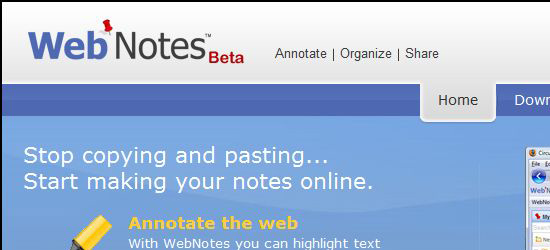
WebNotes is a productivity tool that allows the user to highlight text on web pages, create sticky notes and stick them to any place on the page and save those annotations to a WebNotes account. The tool also has the handy feature of letting the user share their annotated web page with friends, co-workers or anyone that they wish either by email or with a permalink. This way, there are no messy email attachments to deal with and the other party gets to read their colleague's thoughts on the web article or whatever information the web page contains.

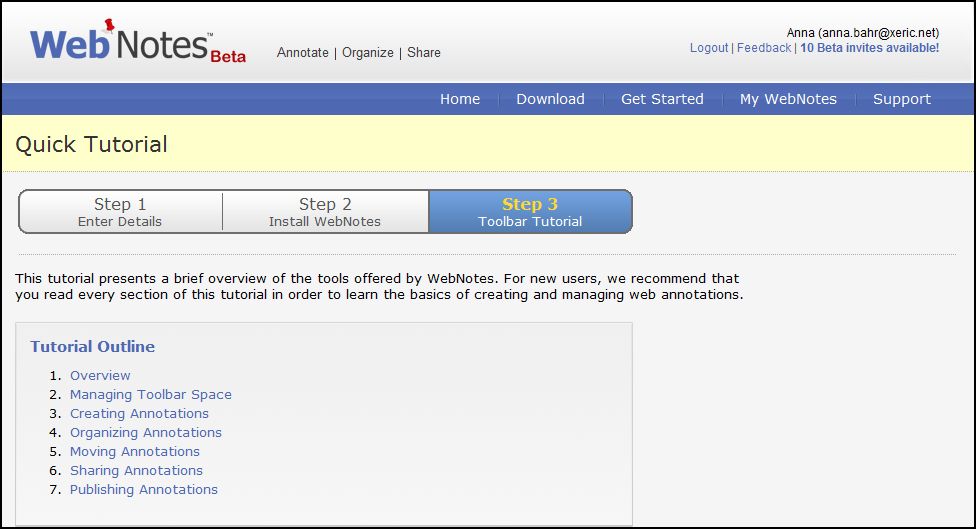
The first step in the process of using Webnotes is to create an account at http://www.webnotes.net/. The process is easy and does not take immense amounts of time to set up. The system will prompt the user to install the Webnotes toolbar and gives a tutorial on how to use the product.

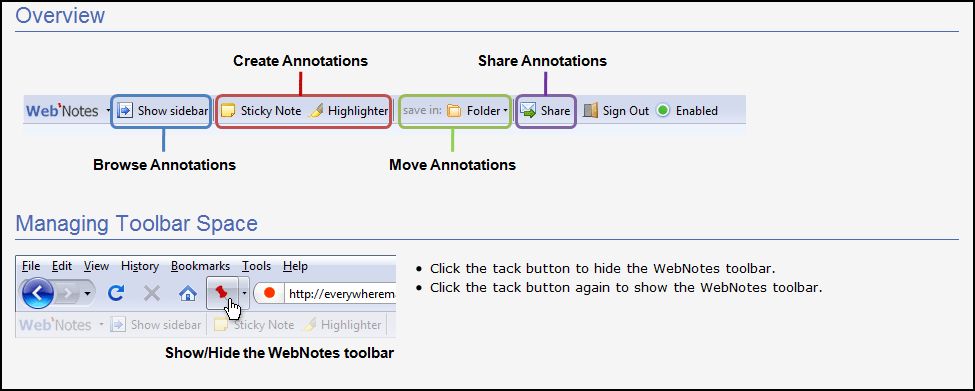
The Webnotes toolbar is very concise and well thought-out, making it easy for the user to navigate.

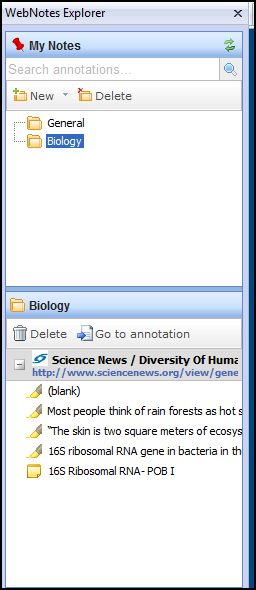
The toolbar conatins the controls necessary for the user to annotate the web page, send it out to another person or save it for later reference. This feature could be very useful especially for college students doing a massive amount of research. The "Organizer" tab will take the user to where the folders for different information are displayed. The user may also create new folders and set up sub-folders for information at this location.

The actual process to annotate the web page is very simple and will not hinder the researcher's productivity. The "Highlighter" tool is rather self explanatory. When the user clicks this tab, he or she simply should move the cursor over the passage that needs to be emphasized for later reference.

One other neat feature of this tool is the "Sticky Note." This featuer makes it very easy for the user to jot notes down next to the passage that inspired the thought. If the research is being conducted for writing a paper or other document, the Sticky Note option is one that can save a person a bunch of time by helping them organize their thoughts preceding the writing process.

In conclusion, Webnotes offers a service that could become very valuable to those wanting to save time and hassle while doing research. For students writing papers in the MLA or APA style, this is a very effective way to organize thoughts and also to save pages that were referenced in the writing of the document. This helps the student ensure that he or she didn't accidentally plaigarize by forgetting to cite one of the sources. Keeping the addresses of all of these web pages in a secure place would be a huge time saver. Also, for those in the workforce that still are required to do lots of research, the organizational and communicational services that Webnotes offers would cut down on the confusion of the work process if the user is working in a team situation. Webnotes simply helps streamline the communication and research process for anyone that conducts extensive research or someone that would like to share interesting information with a friend or colleague.